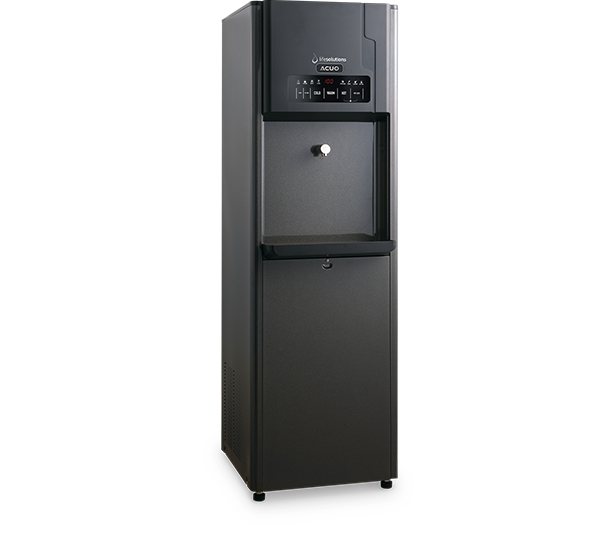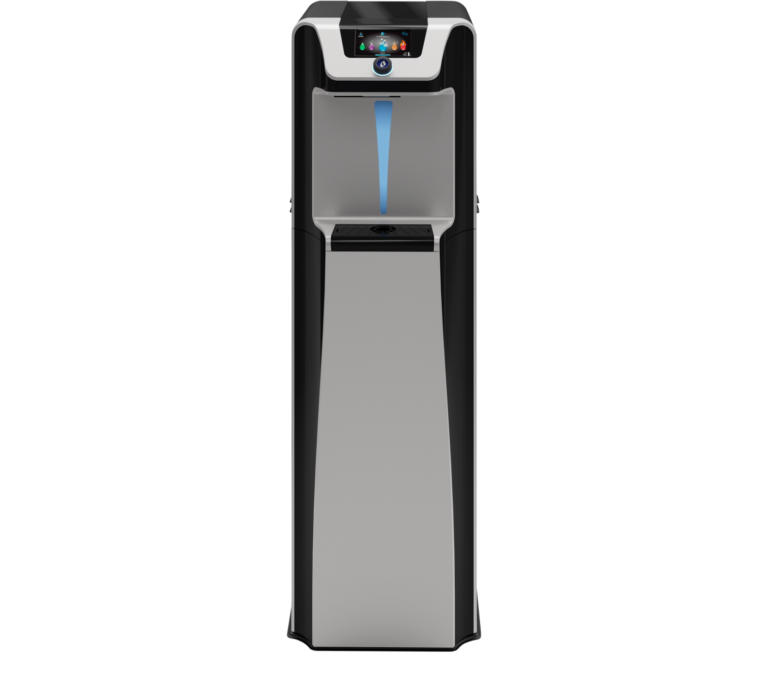
LANA, the competent and essential freestanding water dispenser. Moderate capacity serving up to 50 people. Delivers hot, warm or cold pure drinking water. Modern and compact design. Features an inbuilt TDS reader, leakage detection system, digital temperature control, and intelligent energy-saving function. Zinc, White, and Champagne color options available.
 HOT
HOT
 WARM
WARM
 COLD
COLD
All water, including warm and cold, is heated to at least 90°C before being dispensed.
When leakage occurs, the system will shut off the water inlet to prevent further leaking.
Users can easily read the Total Dissolved Solid level from the water tank using the display panel.
Energy saving mode can be activated at manually for up to 60 hours.
The LED display is able to show the water temperature and system status.
Hong Kong, Macau, and multiple cities in mainland China.
Reverse Osmosis (RO) is the most effective filtration technology available. The RO process works by separating contaminants from water by forcing the water through a semi-permeable membrane. This membrane acts as a physical barrier to remove all particles larger than 0.1 nanometer.
For example, the membrane may allow passage of water molecules, but blocks molecules of dissolved salt or other harmful contaminants. Unwanted molecules are blocked and discarded by the membrane while the ultra-pure water continues on for use or further treatment.
This process takes any unwanted molecules retained by the membrane and sweeps them away to your drain. This filtration process prevents the membrane’s surface from clogging, thus allowing the filter to last long.
An RO unit has to be connected to drainage to discharge the waste water produced during filtration process which brings away the impurities filtered by the RO membrane. This prevents clogging and fouling of filters.
Reverse Osmosis (RO) membranes are designed to filter out contaminants at the molecular level. It is absolutely essential to remove contaminants larger than 5 microns before passing it to the RO membrane to prevent fouling and clogging.
We assess your specific needs and customise the solutions to accommodate your requirements.
Smooth and hassle-free installation process by our experienced in-house technicians
To maintain peak performance for your filtration and water dispenser, regular maintenance and filter replacement are essential. Our service team will pre-schedule filter replacements with you, frequency depends on filter lifespan, site conditions, and actual usage, ensuring that your system remains long-lasting, robust, operates properly to provide water at its highest level of purity, quality, and taste.
Under our warranty, we offer unlimited call-outs, repair works, and parts replacements. Our dedicated team of technicians ensures a guaranteed call-out within 24 hours, providing precise diagnosis and error fixing using genuine manufacturer parts.
For systems under Life Solutions warranty, we offer additional services such as inspection, deep-cleaning (upon request), relocation, dismantle, disposal, and water quality testing by accredited laboratories (upon request). We are dedicated to providing a complete solution for all your water system needs.